
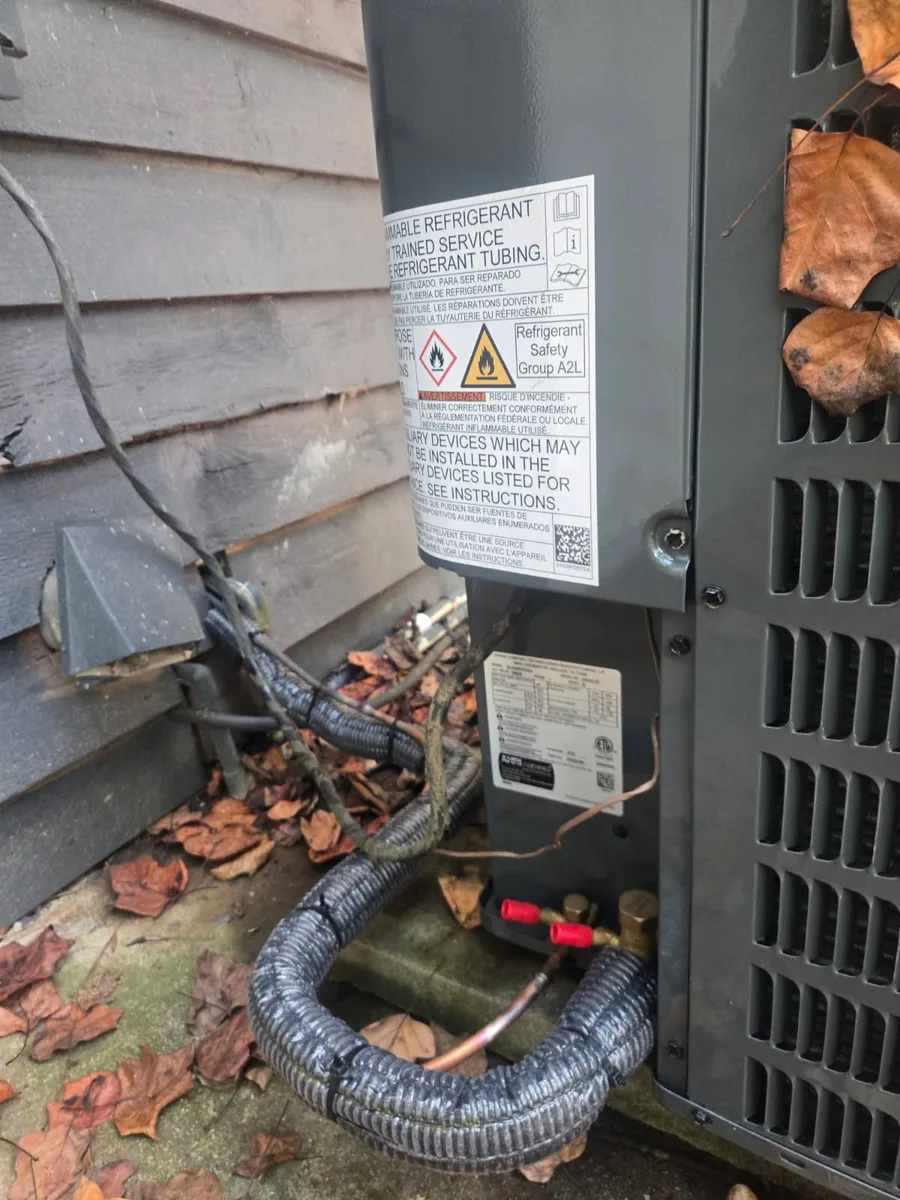
Read the label before you assume anything
Every outdoor unit carries a data plate, and newer equipment also carries a refrigerant safety label on the cabinet. Those markings state which refrigerant the system was built for. A system is engineered around one refrigerant, so the label is the honest starting point for any repair, charge, or replacement conversation.
What is actually changing
New residential air conditioners and heat pumps are now built around A2L refrigerants such as R-454B and R-32 instead of R-410A. The change follows a federal phasedown of higher global-warming-potential refrigerants. It governs what manufacturers may build and ship, not what a homeowner is required to own.
Your existing R-410A system does not stop being serviceable
Equipment that is already installed can keep running and can keep being repaired. Nothing in this transition requires you to replace a working R-410A system. What can shift over time is the supply and cost of R-410A for service work, which is worth asking about before authorizing an expensive sealed-system repair on older equipment.
A2L changes handling, not day-to-day use
A2L refrigerants are classified as mildly flammable, which changes how they are stored, transported, leak-tested, and charged. Manufacturers respond with labeling and, in many designs, leak detection built into the equipment. For a homeowner, the practical effect is that the technician needs refrigerant-specific training, tools, and parts.
Refrigerants are not interchangeable
A system cannot be topped off with a refrigerant it was not designed for, and refrigerant is not consumed the way fuel is. If a system is low, there is a leak somewhere. Adding refrigerant without locating and repairing that leak treats the symptom and leaves the original failure in place.
Partial replacements can create a mismatch
Replacing only the outdoor unit on an older system can leave a mismatch in capacity, metering, and refrigerant. When indoor and outdoor equipment are not a matched set, the result can be reduced efficiency, comfort complaints, or a warranty problem. Ask whether a proposal covers the coil, the air handler or furnace, the line set, and the metering device.
The rest of the installation still decides the result
Line-set condition and sizing, electrical supply, condensate drainage, duct capacity, and a load calculation shape comfort and operating cost more than the name of the refrigerant. A careful installation on either refrigerant will outperform a rushed installation on the newest one.
Questions worth asking
Ask which refrigerant your current system uses, which refrigerant a proposed system uses, whether the indoor and outdoor equipment are a matched set, what happens to the existing line set, and what the labor and parts warranty covers. A good answer explains the finding before it explains the recommendation.